


In India's booming gig economy and enterprise hiring landscape, scaling operations often means onboarding hundreds or thousands of workers weekly. But rapid growth brings a hidden threat: fraud, identity mismatches, and compliance pitfalls. High-volume background checks emerge as the linchpin for risk-free expansion, enabling businesses to verify candidates at scale without slowing momentum.
This playbook equips enterprises with actionable strategies for implementing high-volume background checks tailored to India's unique regulatory environment—from Aadhaar validations to criminal record scrutiny under the Indian Penal Code. By mastering these tactics, you can scale confidently, cut fraud by up to 40%, and slash verification times from weeks to hours.
Why High-Volume Background Checks Are Non-Negotiable in India
India's workforce is massive and dynamic, with over 500 million workers, many in gig and contract roles. Enterprises face escalating risks: fake documents plague 20-30% of applications, per industry reports from NASSCOM. Manual checks falter under high volumes, leading to costly hires—think ₹50,000-₹2 lakh per fraudulent employee in lost productivity and legal fees.
High-volume background checks automate this process using APIs, AI-driven matching, and integrations with government databases like UIDAI, EPFO, and state police records. They ensure compliance with laws like the Personal Data Protection Bill (expected full rollout soon) and reduce risks from synthetic identities or employment gaps.
Key Benefits for Scaling Enterprises:
- Speed: Verify 1,000+ candidates daily, with 90% automated approvals.
- Accuracy: AI cross-references reduce false positives by 70%.
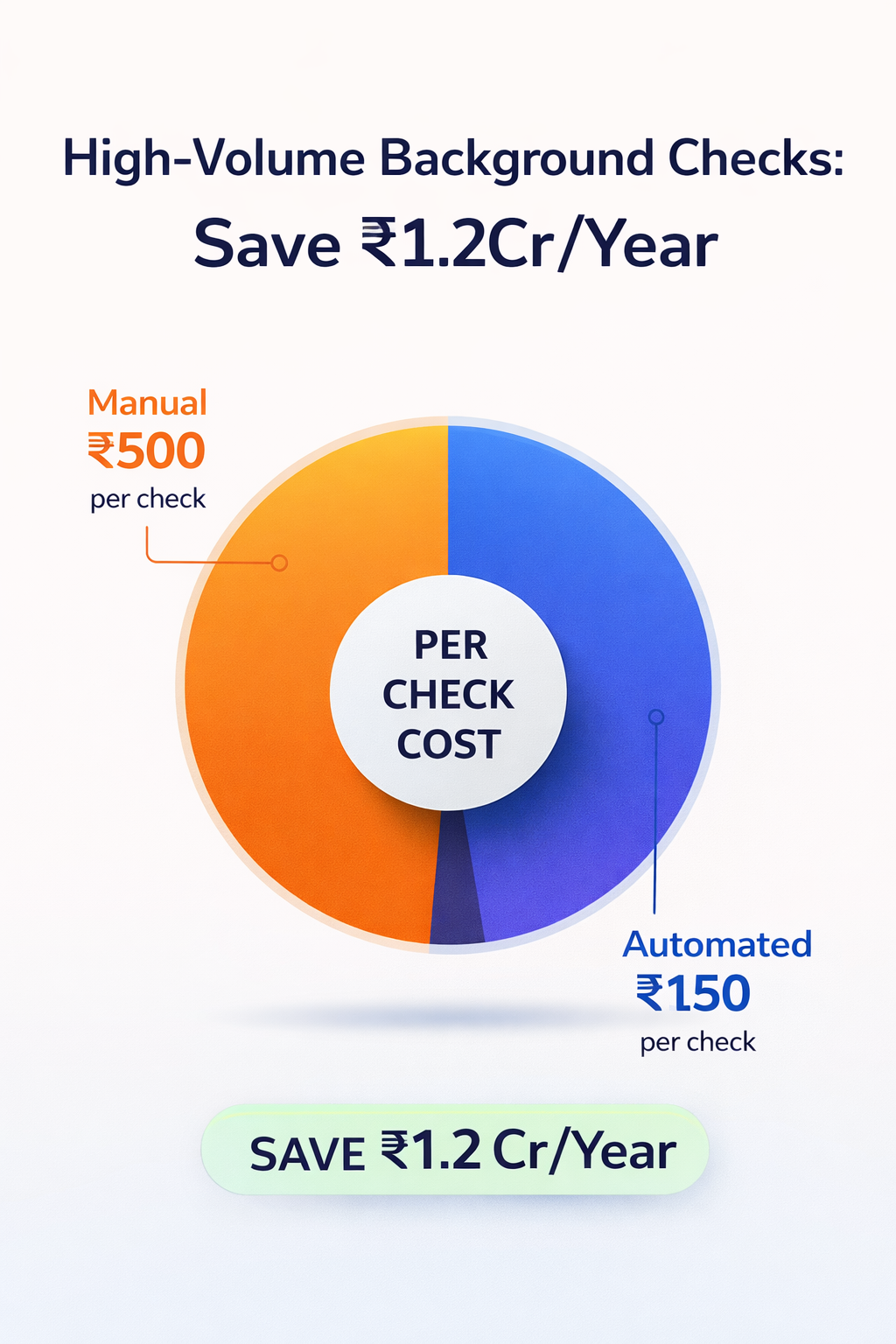
- Cost Savings: Drop per-check costs from ₹500 to ₹100-₹200.
- Scalability: Handle seasonal spikes without proportional staff increases.
Without them, scaling invites risks like reputational damage from data breaches or lawsuits under Section 66C of the IT Act.
Step-by-Step Playbook for High-Volume Implementation
Step 1: Audit Your Current Verification Gaps
Start with a baseline. Map your hiring volume—e.g., 5,000 monthly checks—and identify bottlenecks. Common Indian pain points include Aadhaar-PAN mismatches (affecting 15% of cases) and delays in police verification (up to 30 days).
Action Items:
- Segment checks: Basic (ID proof) for 70% of hires; advanced (criminal, address) for high-risk roles.
- Benchmark TAT: Aim for under 24 hours end-to-end.
- Tool: Run a free audit using platforms compliant with MeitY guidelines.
Step 2: Choose the Right Tech Stack for India
Opt for platforms with deep integrations into Indian ecosystems. Prioritize those supporting e-KYC via DigiLocker, CIBIL for financial history, and TRAI for telecom traces.
Core Components:
- API-First Platforms: Real-time pulls from 50+ sources, including MCA for company directorships.
- AI Fraud Detection: Flags anomalies like duplicate PANs or Photoshopped photos.
- Bulk Upload: CSV/Excel processing for 10,000+ records.
- India-Specific: GSTIN validation and voter ID cross-checks.
Select vendors with 99.9% uptime and ISO 27001 certification to meet RBI and SEBI standards.
Step 3: Design a Tiered Verification Model
Not all hires need the same scrutiny. Implement tiers to optimize costs and speed.
Tier | Volume Focus | Checks Included | TAT | Cost per Check |
Basic | 80% (Entry-level) | Aadhaar, PAN, Bank KYC | <1 hour | ₹50-₹100 |
Standard | 15% (Mid-level) | + Employment, Education | < 24 hours | ₹150-₹300 |
Premium | 5% (Exec/Sensitive) | + Criminal, Global Watchlists | 48-72 hours | ₹400+ |
This model handles high-volume background checks efficiently, with automation covering 95% of basic tiers.
Step 4: Integrate Seamlessly with HR Tech
Embed verification into your ATS (e.g., Workday, BambooHR) or custom portals. Use webhooks for instant status updates, triggering next steps like offer letters.
Pro Tip: For gig platforms, build no-code workflows via Zapier, auto-rejecting 10-20% of risky profiles pre-onboarding.
Pilot with 500 checks: Track metrics like hit rate (fraud caught) and NPS from hiring teams.
Step 5: Ensure Compliance and Data Security
India's regs are stringent—think DPDP Act for consent and localization. Mandate explicit opt-ins, encrypt data at rest/transit, and audit logs for 7 years.
Best Practices:
- Annual third-party audits.
- Role-based access (RBAC) for HR vs. compliance teams.
- Fallback to manual for 5% edge cases, like rural address proofs.
Non-compliance fines can hit ₹250 crore—don't risk it.
Step 6: Measure, Optimize, and Scale
Post-launch, dashboard KPIs: Cost per verification, fraud rate (<2%), and ROI (typically 5-10x from avoided bad hires).
Optimization Hacks:
- ML feedback loops: Retrain models on your data for 15% accuracy gains.
- Volume Discounts: Negotiate as you hit 50,000 checks/month.
- Quarterly Reviews: Adapt to new regs like Digital India mandates.
Enterprises like Zomato and Swiggy scaled to lakhs of verifications using these tactics, cutting fraud by 35%.
Overcoming Common High-Volume Pitfalls
High volumes amplify errors. Watch for:
- Data Overload: Use deduplication to merge similar profiles.
- Vendor Lock-In: Multi-vendor strategies for redundancy.
- Peak-Time Slumps: Hybrid cloud setups for Diwali hiring surges.
Real-World Example: A logistics firm in Bengaluru processed 20,000 driver checks monthly. Switching to automated high-volume background checks dropped TAT from 7 days to 4 hours, saving ₹1.2 crore annually.
Future-Proof Your Scaling Strategy
As India's gig market hits $455 billion by 2025 (NITI Aayog), AI advancements like biometric NFTs and blockchain ledgers will redefine checks. Start now: Hybrid human-AI models predict 50% faster scaling by 2027.
Ready to implement high-volume background checks without the risks? Partner with Gigin AI for India's most robust BGV platform—seamless API integrations, 99% accuracy, and compliance-first design.
Book a free demo today and scale smarter.